
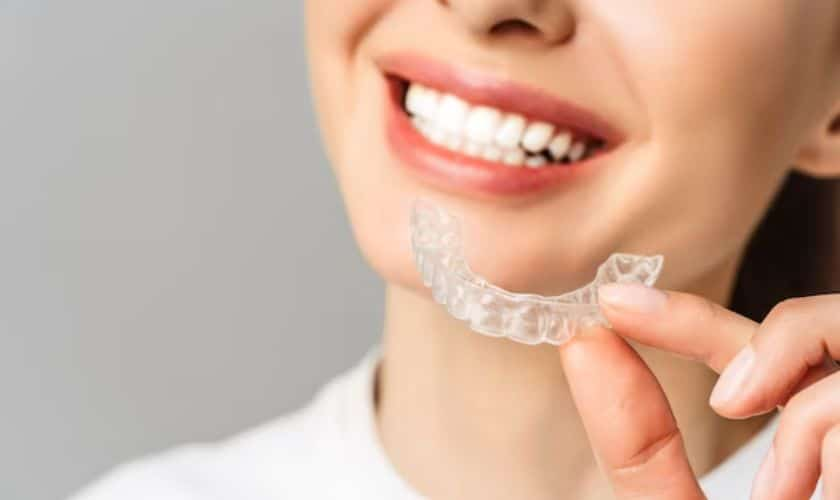
Remember when straightening your teeth meant years of metal brackets and rubber bands? Clear aligners have quietly become the default choice for a huge share of people, and the technology behind them just took another real leap forward. Here’s what’s genuinely changed for anyone considering this route.
AI Is Now Doing the Heavy Lifting on Treatment Planning
This is the biggest shift under the hood. Treatment planning software now leans heavily on AI driven simulations to map out exactly how each tooth needs to move, week by week, before a single aligner is even manufactured. What used to require a lot of manual guesswork from an orthodontist now gets modeled digitally first, which is a big part of why more complex cases, deep overbites, certain underbites, and crossbites that clear aligners used to struggle with, are becoming genuinely treatable without switching to traditional braces.
Attachments Just Got Their Own Upgrade Too
Here’s a detail that sounds small but actually matters a lot clinically. A new 3D printed attachment system creates and bonds the small tooth colored bumps that help aligners grip and rotate teeth more precisely, aiming to reduce the inconsistency that used to come from placing these attachments by hand. More consistent attachments generally mean more predictable tooth movement, which translates into fewer surprise adjustments partway through treatment.
Scanning Technology Is Getting Sharper and Faster
The starting point for any aligner treatment, the initial scan of your mouth, has also improved. Newer intraoral scanners are capturing more detailed 3D imaging, giving orthodontists a clearer starting picture to plan around. Better input data at the very beginning of treatment tends to mean fewer mid course corrections later, since the whole treatment plan is built on that first scan.
Patients Can Now See Their Future Smile Before Committing
One of the more patient facing updates is a simulation tool that shows people what their smile is expected to look like after treatment is complete, before they’ve committed to anything. It sounds like a small thing, but it’s becoming a real factor in whether patients actually say yes to treatment, since seeing a realistic preview of the outcome makes the decision feel a lot less abstract than staring at a mouth full of trays.
Material Science Has Quietly Made Aligners More Comfortable
The plastic itself has changed generation over generation, with newer aligner materials designed to apply more consistent, gentler pressure throughout each two week wear cycle rather than tapering off partway through. The practical result for patients tends to be less of that sharp, uncomfortable pressure right after switching to a new tray, and a smoother overall experience switching between sets.
Remote Monitoring Is Becoming Standard, Not a Novelty
A growing number of aligner systems now pair with a smartphone app that lets orthodontists check in on progress between office visits, sometimes flagging if a tooth isn’t tracking the way it should before the patient even notices anything feels off. For adults juggling a full schedule, that means fewer unnecessary in person visits just to confirm everything’s on track.
Compliance Is Still the Real Make or Break Factor
None of this technology matters much if the aligners aren’t actually being worn. Orthodontists consistently point to non compliance, taking trays out for a meal or a coffee and simply forgetting to put them back in for hours, as the single most common reason treatment stalls or takes longer than expected. All the AI planning and material upgrades in the world can’t compensate for trays sitting in a drawer instead of on your teeth for the recommended 20 to 22 hours a day.
The Bottom Line
Clear aligners have moved well past being just a discreet alternative to metal braces. Between AI powered treatment planning, more precise attachments, sharper scanning, and genuinely better materials, the technology is now capable of handling cases that would have been sent straight to traditional braces just a few years ago. The tools have gotten smarter. The success of any individual treatment still comes down to the person wearing them consistently, exactly as prescribed.
This content is for general informational purposes and isn’t medical advice. Consult a licensed orthodontist to find out if clear aligners are right for your specific case.


